
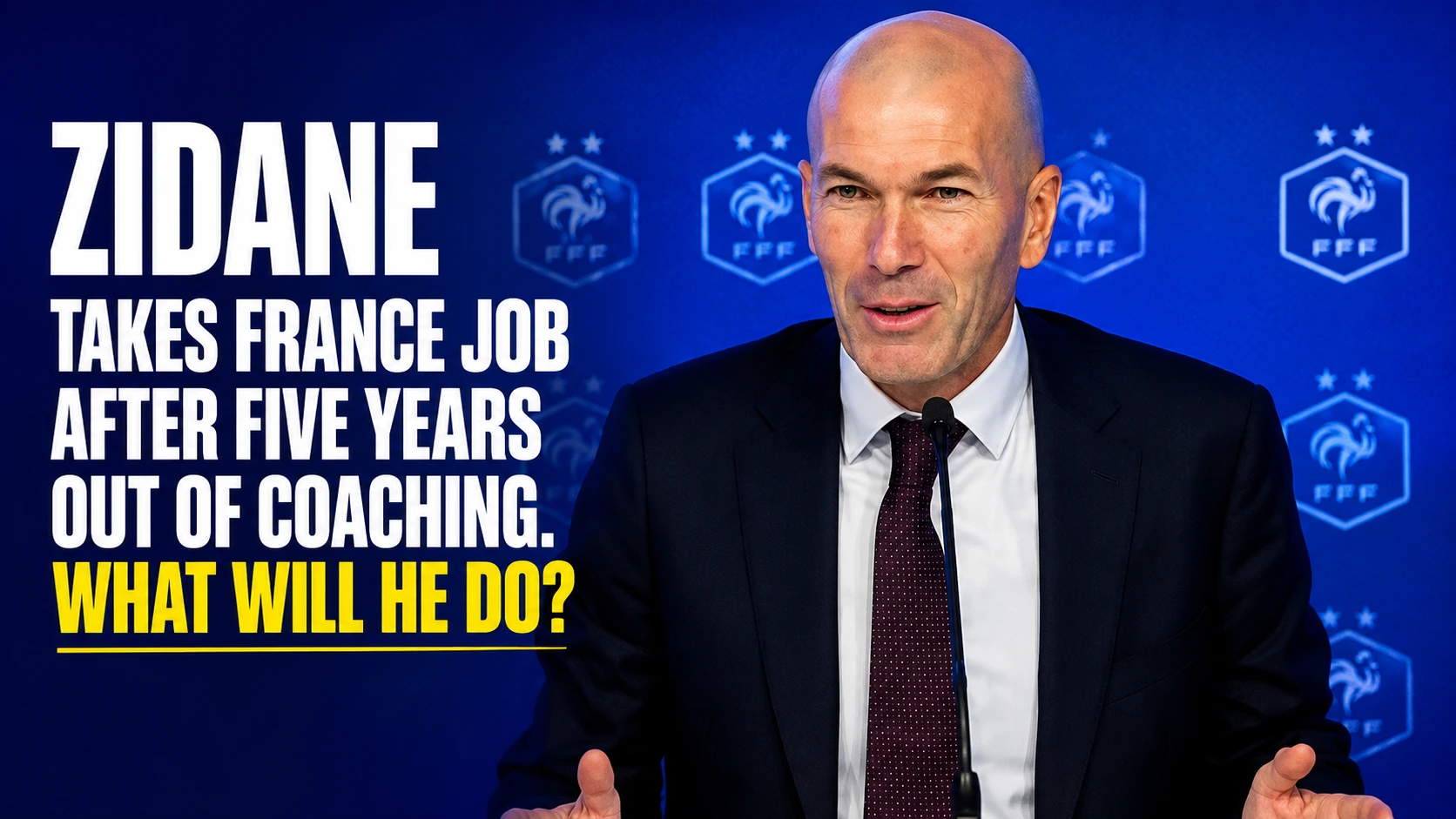
Zinedine Zidane is officially France’s new head coach. His appointment was confirmed on 28 July 2026, his four-year contract begins on 1 August, and his first match will be away to Turkey on 25 September.
What happens next is less certain. Zidane has not named his staff, confirmed Kylian Mbappé as captain or revealed a formation. His record at Real Madrid nevertheless points towards purposeful possession, tactical flexibility, strong player management and a greater emphasis on balancing France’s formidable attack with a midfield capable of controlling elite opponents.
Verified Facts: Zidane's Appointment
Official Data| Appointment Confirmed | Yes (28 July 2026) |
|---|---|
| Start Date | 1 August 2026 |
| Contract Length | Four years, through 2030 World Cup |
| Replaces | Didier Deschamps |
| First Match | Turkey away on 25 September (UEFA Nations League) |
| Coaching Staff | To be presented early September |
| Mbappé Captaincy | Undecided publicly |
| Formation | Unconfirmed (Tactical previews below) |
Why France Chose Zidane
The conclusion of Didier Deschamps’ historic fourteen-year tenure left the French Football Federation (FFF) with a profound existential question: how to transition from an era defined by reactive tournament pragmatism to one that maximizes the most exceptionally gifted offensive pool in world football. The answer was uniquely singular.
Zinedine Zidane is not simply a tactical successor; he is an institutional figurehead. Having delivered France’s first World Cup as a mesmerising playmaker in 1998 and conducted Real Madrid to three consecutive Champions League triumphs between 2016 and 2018 as a strategist, Zidane possesses an undisputed authority. In a Les Bleus dressing room replete with global iconoclasts and intense scrutiny, Zidane commands instant psychological reverence that no systematic ideologue could replicate.
"When Zizou enters a dressing room, even the most accomplished superstars fall silent. He doesn't just teach football; he emanates the absolute standard of winning."
What Will Zidane Do First?
With less than sixty days separating his August 1 contract initiation from a daunting UEFA Nations League opener in Turkey on September 25, Zidane faces an immediate tripartite agenda:
- Assembling His Technical Staff: While Deschamps relied heavily on Guy Stéphan as his tactical sounding board, Zidane is expected to present his fully formed staff in early September. Reports indicate trusted physical conditioning specialist Grégory Dupont—the architect of France's 2018 physical dominance and Madrid's 2020 Liga title sprint—could play a fundamental role, alongside former Real Madrid tactical analysts.
- Resolving the Mbappé Leadership Dynamic: Perhaps his most delicate interpersonal test is settling the public ambiguity surrounding the national team captaincy. Regardless of whether Mbappé retains the armband or shares leadership responsibilities within a broader player council, Zidane will sit down privately with the Real Madrid star before autumn to establish explicit relational boundaries.
- Drafting the Maiden Nations League Squad: France’s squad requires subtle reinvigoration without discarding tournament experience. Zidane's preliminary squad selection against Turkey will serve as the premier litmus test of his tactical direction, revealing whether veteran pillars retain their guaranteed stature or if emerging Ligue 1 and European prodigies are vaulted immediately into starting prominence.
What Style Will Zidane Bring to France?
To understand what Les Bleus will look like under Zidane, one must debunk the persistent myth that he lacks an overarching tactical philosophy. While never wedded to a dogmatic Guardiola-style positional grid, Zidane’s methodology at the Bernabéu was predicated on elite structural adaptability and interpersonal intelligence.
Purposeful Possession
Unlike Deschamps' willingness to cede the ball against elite opposition, Zidane demands controlled territorial dominance. Passing loops are structured to condense opponents on one flank before executing rapid lateral switches to isolate explosive wingers in 1-on-1 matchups.
Formation Flexibility
Zidane is renowned for shifting shapes mid-match without making substitutions. Whether deploying a flat 4-3-3, pivoting to a wide 4-2-3-1, or forming a classic diamond midfield, his sides modify their pressing triggers and build-up patterns based on real-time game states.
Freedom Within Structure
Rather than tethering creative talents to strict chalk-lined zones, Zidane licenses attacking improvisers to drift and combine organically in the final third—provided central midfielders instinctively rotate to seal defensive transition avenues.
Individual Analysis
Zidane excels at macro-synergies: placing players in relational pairings where their strengths amplify and deficiencies vanish. He tailors defensive coverage schemes specifically to preserve energy for his primary match-winners.
The Biggest Tactical Problem: France Cannot Simply Select Every Attacker
The sheer saturation of French offensive horsepower is both a profound blessing and a definitive tactical hazard. Between Kylian Mbappé, Ousmane Dembélé, Bradley Barcola, Marcus Thuram, Michael Olise, Christopher Nkunku, and Randal Kolo Muani, the temptation from external pundits will always be to deploy an all-out offensive quartet.
However, modern international football punishes imbalanced structures with surgical lethality. During late-tournament heartbreaks, France frequently faltered when defensive transition tracking disintegrated on the flanks. Zidane’s foremost structural challenge will be resisting the populist urge to cram every star forward onto the pitch. To achieve the territorial control he favors, he must occasionally sideline world-class attackers in favor of industrious tactical balancing agents.
Zidane’s Two Most Plausible France Formations
Based on his structural preferences in Madrid and France's existing talent pool, Zidane is anticipated to alternate between two distinct tactical blueprints throughout the upcoming Nations League cycle:
Option 1: The Dynamic 4-2-3-1
Designed to unleash maximum offensive fluidity while anchoring the center of the park with an impermeable double pivot. This setup relies on hyper-dynamic wing-backs providing overlapping width while inside inverted forwards operate between opposition lines.
A powerful physical foundation with Saliba and Konaté centrally, protected by an athletic double engine of Tchouaméni and Camavinga (or Zaïre-Emery).
Dembélé operating from the right flank, Olise or Griezmann threading central key passes, and Mbappé exploding off the favored left wing.
A traditional physical number nine like Marcus Thuram occupying center-backs, creating clear lateral running lanes for Mbappé to exploit.
Option 2: The Control 4-3-3 / 4-3-1-2 Diamond
Inspired by Zidane's legendary Champions League three-peat diamond at Madrid, this formation prioritizes complete central midfield numerical supremacy against high-pressing European superpowers like Spain or England.
A technically dominant triad combining ball-winning tenacity and vertical progression—pairing Tchouaméni, Camavinga, and a roving box-to-box facilitator.
An advanced free role directly behind the strikers, allowing an elite creator to operate untouched between defensive midfield blocks.
Mbappé partnered alongside a highly mobile forward (such as Barcola or Dembélé), utilizing split horizontal runs to devastate transitional defenses.
Could Zidane Recall Camavinga to Center Stage?
Under Deschamps, Eduardo Camavinga frequently endured paradoxical treatment: widely acknowledged as a generational midfield engine, yet consistently relegated to super-sub status or emergency left-back duties during definitive international knockouts.
Zidane’s arrival signals a monumental watershed moment for the Real Madrid dynamo. Having intimately analyzed Camavinga's exponential growth in Spain, Zidane values midfielders capable of breaking pressing lines through vertical ball-carrying and ferocious counter-pressing recovery. Expect Camavinga to be immediately upgraded from a utility option to an indispensable core pillar of Zidane’s tactical engine room, replicating the indispensable stability Casemiro and Luka Modrić once provided him in Madrid.
Will Zidane Build Everything Around Mbappé?
No storyline captivates French football more than the symbiosis between the legendary World Cup icon on the touchline and the contemporary captain on the pitch. While public debate persists over whether Mbappé should remain captain, Zidane’s historical track record in managing Cristiano Ronaldo at Real Madrid offers the precise operational roadmap for their partnership.
In Madrid, Zidane convinced Ronaldo to relinquish unnecessary defensive sprints and accept deliberate workload rotation in exchange for unprecedented goal-scoring productivity during decisive spring knockouts. Zidane will neither force Mbappé into rigid tactical straightjackets nor permit total systemic anarchy. Instead, he will architect a protective midfield scaffolding that relieves Mbappé of exhausting tracking obligations, concentrating his supernatural acceleration entirely inside the attacking third.
Is Five Years Away From Coaching a Serious Risk?
When Zidane steps onto the touchline in Turkey this September, exactly 1,943 days will have transpired since his final managerial match—a 2–1 Real Madrid victory over Villarreal on May 22, 2021. In the intervening half-decade, tactical orthodoxy across Europe has accelerated toward highly scripted positional play and relentless high-pressing pressing traps.
Critics legitimately question whether a five-year hiatus blurs sharp in-game reactive instincts. However, international football fundamentally differs from the rigorous daily tactical grinding of club competitions. National team success remains principally governed by emotional cohesion, decisive man-management, set-piece execution, and pragmatic knockout timing—domain areas where Zidane’s genius has always resided. His extended sabbatical has not been spent in isolation; Zidane has continuously observed European developments, waiting exclusively for the ideal moment to accept his national destiny.
What Will Count as Early Success?
The French public and FFF executives will not evaluate Zidane's opening months simply through raw scorelines in the UEFA Nations League, but through clear qualitative benchmarks:
- Restoration of Attacking Fluidity: Evolving Les Bleus away from tedious, conservative build-up sequences into a dynamic, proactive collective that excites supporters.
- Dressing Room Tranquility: Eradicating external factional debates and establishing unified collective accountability throughout the autumn international windows.
- Tactical Integration of the New Wave: Seamlessly bedding in emerging talents from Ligue 1 and France's recent Olympic setups into stable senior roles.
- Authoritative Qualification Trajectory: Laying an unshakeable structural groundwork through 2026 and 2027 that positions Les Bleus as absolute prohibitive favorites heading into Euro 2028 and the 2030 World Cup.
Likely Verdict: A Match Written in Destiny
Zinedine Zidane’s appointment as France head coach is far more than a sentimental homecoming; it is a profound strategic alignment of history, ambition, and elite leadership. While his five-year coaching hiatus introduces fractional unpredictability, Zidane remains the ultimate competitive equalizer. By instilling purposeful possession and emotional equilibrium into world football’s deepest talent reservoir, Zizou transforms Les Bleus from formidable tournament grinders into an awe-inspiring modern superforce primed for global dominance through 2030.
Sponsored
[ Google AdSense — In-Article Native Ad ]
Frequently Asked Questions
When is Zinedine Zidane's first match as France manager?
Zidane’s official managerial debut for Les Bleus will take place on 25 September 2026, away against Turkey in the group stage of the UEFA Nations League.
How long is Zinedine Zidane's contract with France?
Zidane has signed a four-year contract with the French Football Federation (FFF), beginning on 1 August 2026 and extending through the conclusion of the 2030 FIFA World Cup.
Will Kylian Mbappé remain France captain under Zidane?
Zidane has not yet confirmed his captaincy structure publicly. He is expected to hold private meetings with Kylian Mbappé in August before formally announcing his leadership group in early September.
What tactical style will Zinedine Zidane bring to the French national team?
Zidane is expected to transition France away from Didier Deschamps' reactive counter-attacking framework toward purposeful possession, tactical fluidity between 4-2-3-1 and diamond midfield shapes, and enhanced relational synergy in the attacking third.
Why was Zidane out of coaching for five years before taking the France job?
Following his departure from Real Madrid in May 2021, Zidane consistently rejected numerous elite club and national team offers, remaining candid about his singular ambition to manage the French national team once Didier Deschamps' tenure concluded.