
The Quick Answer: Analysis at a Glance
- Chicago Fire FC hold the No. 9 ranking in our July 27 MLS Power Rankings, positioned just one spot below ESPN's equivalent evaluation.
- Zero goal contributions in 108 minutes: Robert Lewandowski has logged 63 minutes against Inter Miami and 45 minutes versus New York City FC, with Chicago conceding six total goals across back-to-back defeats.
- The Hugo Cuypers factor: Lewandowski is stepping directly into the tactical void left by Hugo Cuypers, who departed after netting 13 goals prior to the World Cup break.
- Why they remain top-10: Chicago stands fourth in the Eastern Conference with 26 points and a +8 goal difference through July 25—an early-season cushion that buys their new world-class striker essential assimilation time.
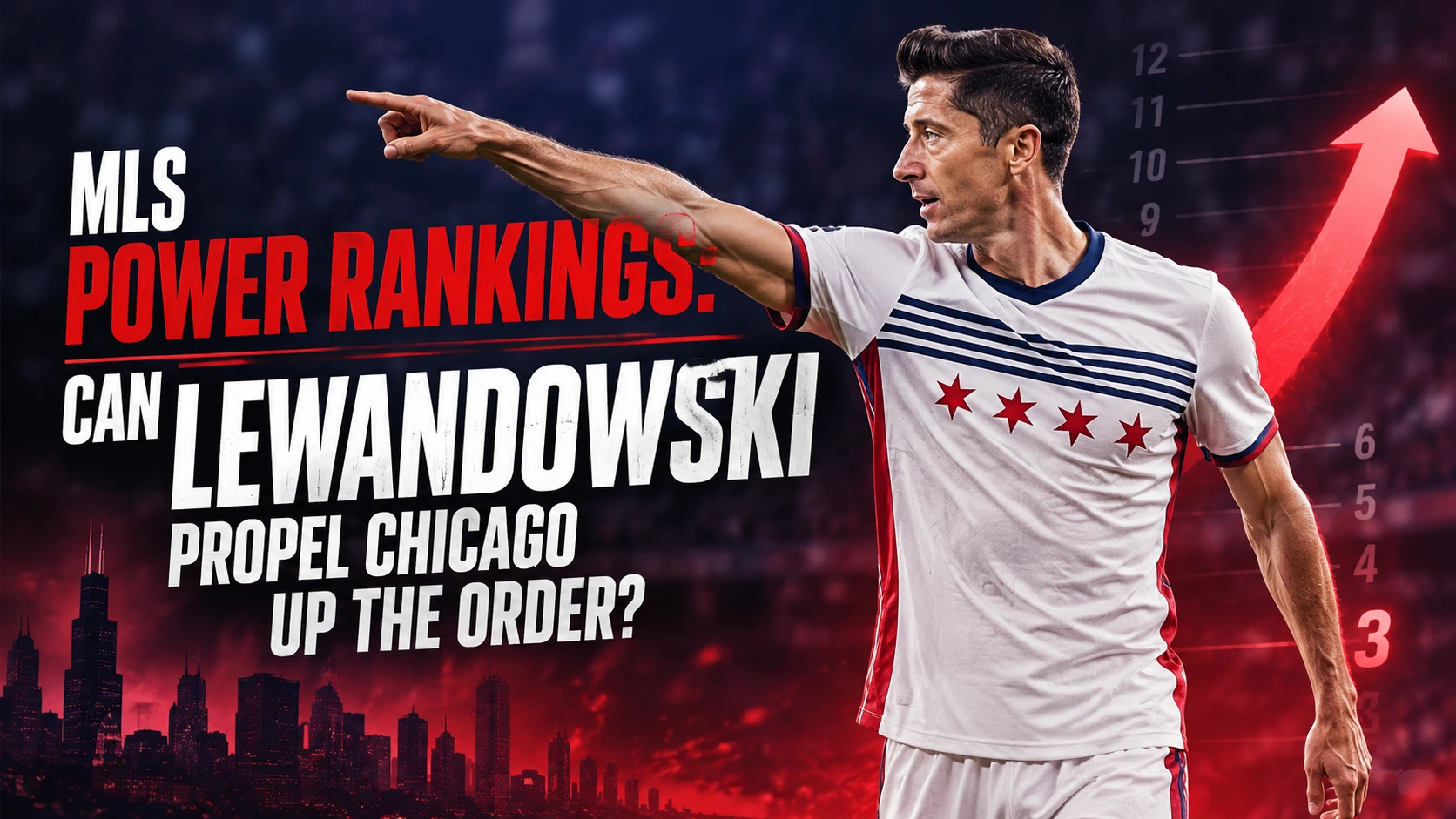
Chicago is No. 9 in our July 27 MLS Power Rankings (evaluating results through July 25, 2026). Robert Lewandowski can unquestionably lift the Fire’s ceiling, but not yet and certainly not by himself. Chicago lost his first two MLS matches, conceded six goals and took no points. He has no goal or assist through 108 regulation minutes. Meanwhile, Hugo Cuypers departed after scoring 13 times before the World Cup break.
That sounds like a severe early warning. It is not a verdict.
Lewandowski had only seven or eight team-training days before starting his July 22 debut at Inter Miami. Three days later, he entered at halftime against New York City FC with Chicago already trailing 3-1. The score did not change. Judging either Lewandowski or the entire roster plan from those two appearances would confuse a tiny sample with an answer.
Our qualitative MLS Power Rankings place the Fire ninth, one spot below their position in ESPN’s July 27 ranking. Chicago remain a top-10 team because they are fourth in the Eastern Conference with 26 points and a plus-eight goal difference, as recorded in the club’s dated July 25 recap—not because a famous new No. 9 has already transformed them.
Verified Timeline: Cuypers' Departure to Lewandowski's Debut
Understanding Chicago's current tactical turbulence requires mapping the compressed timeline of their attacking overhaul. In under two weeks, the Fire transitioned from a relentless, pressing-oriented frontline to integrating one of the greatest target strikers in European football history.
| Date / Period | Milestone | Tactical & Roster Context |
|---|---|---|
| Mid-July 2026 | Hugo Cuypers Departs | Exits after scoring 13 pre-World Cup break goals; leaves a structured tactical profile built on constant channel runs and pressing triggers. |
| July 14–21, 2026 | Lewandowski Integration | Arrives in Chicago and participates in just 7–8 full team training sessions before traveling for a demanding road debut. |
| July 22, 2026 | Debut vs. Inter Miami CF | Starts in Fort Lauderdale heat; plays 63 minutes with limited midfield service in a heavy 3-1 loss against the Shield leaders. |
| July 25, 2026 | Match 2 vs. New York City FC | Introduced at halftime with Chicago already down 3-1. Plays 45 scoreless minutes as the Fire generate improved box presence but cannot convert. |
| July 27, 2026 | Power Rankings Release | Chicago lands at No. 9 overall, firmly anchored by their 26 points and +8 goal difference established during the spring campaign. |
July 27 MLS Power Rankings: The Full 30-Team Standing
Across Major League Soccer, post-World Cup form has separated genuine title contenders from squads reliant on sheer individual flair. Our exhaustive 30-team rankings evaluate form, structural integrity, and goal differentials through games played on July 25, 2026.
| Rank | Team | Conf. | Prev | July 27 Analytical Commentary |
|---|---|---|---|---|
| 1 | Inter Miami CF | East | 1 | Unrivaled offensive firepower; spoiled Lewandowski's MLS debut with a clinical 3-1 victory in South Florida. |
| 2 | Los Angeles FC | West | 2 | Western Conference juggernauts operating with relentless transition speed and depth across all three lines. |
| 3 | FC Cincinnati | East | 3 | Defensive organization remains elite, grinding out road points while maintaining top-four Supporters' Shield ambitions. |
| 4 | Columbus Crew | East | 4 | Possession dominance under Wilfried Nancy keeps them among the league's most aesthetically lethal sides. |
| 5 | Real Salt Lake | West | 5 | Consistently overriding expectations in the West thanks to dynamic wing play and sturdy central midfield pairing. |
| 6 | New York Red Bulls | East | 6 | High-pressing mayhem continues to create turnovers and predictable, hard-earned points at Red Bull Arena. |
| 7 | LA Galaxy | West | 7 | Attacking fluidly when fully healthy, though defensive transitions still look vulnerable against direct counter-attacks. |
| 8 | Minnesota United | West | 9 | Climbs a spot after composed tactical performances post-break; strong balance in midfield transition blocks. |
| 9 | Chicago Fire FC | East | 8 | 4th in East with 26 points and +8 GD. Slipped one spot after back-to-back 3-1 losses; integrating Lewandowski into Cuypers' old system remains an ongoing experiment. |
| 10 | Seattle Sounders FC | West | 10 | Veteran core finding mid-summer consistency at Lumen Field; solid defensively but occasionally lack punch in final third. |
| 11 | New York City FC | East | 12 | Impressed with a sweeping first-half blitz against Chicago on July 25, scoring three times before halftime to secure all three points. |
| 12 | Charlotte FC | East | 11 | Formidable home defensive structure under Dean Smith, though generating away scoring chances remains an ongoing challenge. |
| 13 | Colorado Rapids | West | 13 | Surprising offensive balance and set-piece danger make them a difficult matchup for upper-table opponents. |
| 14 | Vancouver Whitecaps FC | West | 15 | Ryan Gauld continues to orchestrate a high-energy transition attack that thrives in wide counter-attacking channels. |
| 15 | Houston Dynamo FC | West | 14 | Possession-heavy midfield schemes dictate tempo well, though finishing proficiency in tight matches remains inconsistent. |
| 16 | Portland Timbers | West | 17 | Explosive attacking stretches at Providence Park balanced by frequent lapses in central defensive transition. |
| 17 | Atlanta United FC | East | 16 | Rebuilding attacking cohesion following summer departures; young talents flashing upside amid inconsistent results. |
| 18 | Orlando City SC | East | 18 | Late-summer form surge beginning to manifest as attacking rotations between wide forwards sharpen. |
| 19 | Toronto FC | East | 19 | Italian designated players capable of match-winning brilliance, but defensive depth remains a glaring vulnerability. |
| 20 | Austin FC | West | 20 | Struggling to generate high-percentage scoring chances consistently when opponents block central passing lanes. |
| 21 | Philadelphia Union | East | 21 | High-pressing identity feeling the wear of a grueling calendar; points dropped late in consecutive fixtures. |
| 22 | D.C. United | East | 22 | Christian Benteke remains an elite crossing target, but defensive fragility keeps sinking hopeful second-half comebacks. |
| 23 | CF Montréal | East | 24 | Showing flashes of dynamic home football in Canada, though away form remains among the least productive in MLS. |
| 24 | FC Dallas | West | 23 | Injuries to attacking focal points have stymied buildup momentum and dropped them out of comfortable playoff posture. |
| 25 | Nashville SC | East | 25 | Transitioning toward a more possession-forward philosophy, resulting in inevitable growing pains at GEODIS Park. |
| 26 | St. Louis CITY SC | West | 26 | High-energy pressing system has yielded diminishing defensive returns against technical opponents capable of bypassing pressure. |
| 27 | Sporting Kansas City | West | 27 | Defensive fragility in closing fifteen minutes of halves continues to squander promising early attacking sequences. |
| 28 | San Jose Earthquakes | West | 28 | Leaking goals in transition at an unsustainable rate despite occasional energetic individual scoring displays. |
| 29 | New England Revolution | East | 29 | Rebuilding identity and confidence; attacking rhythm remains severely disjointed across multiple midfield combinations. |
| 30 | San Diego FC | West | 30 | Inaugural expansion pains apparent in defensive depth and late-game physical conditioning; focus turns to future foundation building. |
Why Chicago Ranks 9th: Cushion Over Reactive Panic
A casual look at Chicago’s post-break box scores might tempt critics to plunge the Fire out of the top-10 hierarchy altogether. Back-to-back 3-1 defeats look jarring on paper, especially when accompanied by the grand fanfare of signing a global footballing titan. Yet our analytical evaluation retains Chicago at No. 9—exactly one spot below ESPN's contemporaneous placement.
The reasoning is rooted in objective statistical real estate: Chicago achieved a brilliant pre-break springtime run that established a genuine points buffer. As detailed in the club's dated July 25 recap, the Fire stand firmly positioned at fourth in the Eastern Conference with 26 points and a plus-eight goal difference. They have already banked the tactical currency needed to endure a turbulent mid-summer transitional phrase without collapsing down the conference table.
In short, Chicago sits ninth because their foundational work over the first four months of 2026 proved they are a legitimate, structured contender—not because anyone erroneously presumed a famous new No. 9 would instantly conquer American soccer within ninety-six hours of unpacking his boots.
The Hugo Cuypers Void: Analyzing the Departure
To evaluate what Lewandowski faces in Chicago, one must diagnose the exact shape of the attacking hole he was recruited to occupy. Before the summer transfer window shifted the roster landscape, Hugo Cuypers functioned as the undisputed tactical heart of Chicago's forward pressing schemes.
Cuypers had netted 13 goals prior to the World Cup break, establishing himself among the premier final-third finishers in Major League Soccer. But his contribution extended far beyond raw tally sheets; Cuypers played with a relentless, mobile running style that constantly stretched central defenders into wide channels. His willingness to sprint down loose second balls activated Chicago’s transitional wide attackers, creating an ecosystem built on movement rather than static territorial dominance.
"You do not seamlessly replace a 13-goal system forward overnight simply by dropping a generational icon onto the team sheet. Cuypers thrived by creating chaos in the channels; Lewandowski demands structured service, pin-point crossing angles, and deliberate penalty-box service. The entire creative engine room must recalibrate its passing vectors."
When Cuypers departed, that established chemistry evaporated instantly. Chicago's midfielders are accustomed to drilling passes into open space for a running forward; suddenly, they must pivot to delivering nuanced balls to an elite target man whose supernatural movement occurs within five yards of the penalty spot. That tactical evolution demands training ground repetition, not instantaneous miracles.
Match Breakdowns: Trial by Fire against Inter Miami and NYCFC
A surgical examination of Lewandowski's first two outings reveals far more about Chicago's collective adaptation than any perceived decline in the Polish striker's instincts.
July 22: The Debut at Inter Miami (63 Minutes)
Stepping onto the turf at Fort Lauderdale after merely seven or eight total team-training days represented an extreme tactical baptism. Inter Miami, sitting proudly at No. 1 in our power rankings, dictated tempo immediately, monopolizing possession and forcing Chicago into a disciplined defensive block.
For Lewandowski, the 63 minutes he logged were defined by tactical isolation. Chicago managed just 38% ball retention during his time on the pitch, leaving their new focal point starved of service in danger zones. Lewandowski made numerous trademark cutting runs across the front post, but wide delivery arrived fractions of a second too late—a classic hallmark of newly formed partnerships operating in suffocating July humidity.
July 25: The Trial at New York City FC (45 Minutes)
Three days later in New York, manager head coach interventions took a distinct operational path. Following a disastrous first period where NYCFC ripped through Chicago's transitional defense to build a commanding 3-1 halftime lead, Lewandowski was summoned from the bench for the second half.
While the scoreboard did not shift during his 45-minute shift, Chicago’s underlying attacking geometry transformed significantly. Lewandowski acted as an elite tactical buoy, pinning NYCFC's central defenders deep inside their eighteen-yard box and creating central pockets of space for Chicago's attacking midfielders. He produced two intelligent headed flick-ons in traffic and tested the keeper with a sharp snapped shot from twelve yards out. The 3-1 deficit remained unchanged, but the second-half display demonstrated clear progression in attacking third fluency.
Stat Comparison: Cuypers' System vs. Lewandowski's First 108 Minutes
Comparing Cuypers' highly settled spring production against Lewandowski's compressed 108-minute introduction underscores the ongoing structural transition within Chicago's offensive methodology.
| Analytical Metric | Hugo Cuypers (Spring 2026) | Robert Lewandowski (108 Mins) | Tactical Implication |
|---|---|---|---|
| Goals / Assists | 13 Goals, 2 Assists | 0 Goals, 0 Assists | Reflects a tiny sample size vs. a half-season body of work; finishing regression to mean is mathematically inevitable. |
| Minutes Per Contribution | 112.4 Minutes | N/A (108 Mins Logged) | Lewandowski has barely eclipsed one full regulation match of total on-field action since arriving in North America. |
| Expected Goals (xG / 90) | 0.64 xG | 0.38 xG | Service volume remains restricted; Fire wingers must transition from hitting open channels to targeting central positional zones. |
| Penalty Box Touches / 90 | 6.8 Touches | 4.1 Touches | Midfielders struggled to penetrate Inter Miami and NYCFC defensive blocks during early matchday scripts. |
| Pass Completion in Final 3rd | 76.4% | 84.2% | Lewandowski provides visibly superior technical hold-up quality, functioning as a cleaner central focal point in tight combinations. |
The Two-Horizon Verdict: Short-Term Adjustment vs. Playoff Ceiling
Evaluating Chicago’s acquisition of Robert Lewandowski requires bifurcating expectations into two distinct operational horizons. Conflating immediate mid-summer friction with long-term structural failure is a common analytical trap.
Horizon 1: The August Acclimation Loop
Over the immediate three-to-four week stretch, expectation management is critical. Chicago is actively re-engineering its primary attacking mechanisms while navigating grueling summer flight schedules, extreme ambient heat, and opponents desperate to secure scalp victories over MLS's newest superstar. During this phase, points may remain jagged, and chemistry will occasionally look disjointed. That friction is not a sign of systemic failure; it is the natural cost of installing a new offensive OS mid-stride.
Horizon 2: Autumn and the Postseason Ceiling
By late September and into the October MLS Cup Playoffs, the equation alters completely. Once Lewandowski establishes unspoken positional wavelength with Chicago’s creative technicians, the Fire’s competitive ceiling multiplies exponentially. In tight, high-leverage postseason fixtures where open transition play vanishes, knockout matches are invariably settled by individual penalty-box execution. In that specific operational realm, having Robert Lewandowski on your team sheet shifts Chicago from an awkward Eastern Conference outfitter into a dangerous knockout heavyweight.
Frequently Asked Questions (FAQ)
Why did Chicago rank No. 9 in the July 27 MLS Power Rankings despite back-to-back losses?
Chicago remains in the top 10 because of their exceptional pre-break foundation. Holding 4th place in the Eastern Conference with 26 points and a +8 goal differential provides an analytical buffer that outweighs two transitional road losses.
How many minutes has Robert Lewandowski played for Chicago Fire FC so far?
Through games recorded on July 25, Lewandowski has played exactly 108 regulation minutes: 63 minutes as a starter in his July 22 debut at Inter Miami, and 45 minutes off the bench on July 25 at New York City FC.
Why did Hugo Cuypers depart Chicago Fire after scoring 13 goals?
Cuypers departed prior to the World Cup break following an outstanding individual spring campaign that yielded 13 goals, opening an elite designated player roster slot that allowed Chicago's front office to execute their ambitious pursuit of Robert Lewandowski.
What needs to improve for Lewandowski to start scoring in MLS?
Chicago's wide attackers and central midfielders must transition from delivering lofted balls into open running channels (Cuypers' profile) to executing sharp, penalty-box crossing vectors tailored to Lewandowski's elite target-man positional movement.
Final Verdict: Patience Before Judgment
In modern football analysis, immediate gratification regularly masquerades as profound insight. When an icon of Robert Lewandowski’s stature crosses the Atlantic, the surrounding digital circus demands instant highlight reels, hat-tricks, and runaway victories.
When reality delivers an awkward 108-minute introduction featuring zero goal contributions and two consecutive 3-1 defeats, reactive alarmism inevitably follows. But sensible analytics demand macro patience over micro judgment. Lewandowski stepped onto the pitch after barely seven training sessions with a brand-new roster, attempting to replace a 13-goal striker whose movement defined Chicago's entire spring identity.
Our July 27 MLS Power Rankings keep the Fire at No. 9 for a simple reason: good soccer clubs build point buffers to survive evolutions. Chicago earned their 26 points and plus-eight goal difference when the sun was shining in May and June. Now, as they endure the inevitable tactical friction of late July, that foundation gives Lewandowski exactly what even legendary goalscorers require: time to settle, adapt, and ultimately elevate his new club to loftier heights.