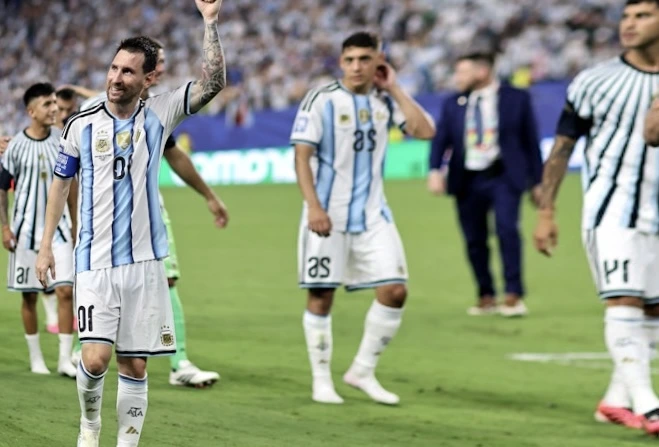
You saw the headlines before you saw the match. "MESSI HUMILIATED?" with a question mark doing all the work. Football news sites made money off your panic before a ball was even kicked in extra time. Meanwhile, the actual story in Miami was better than any clickbait: a nation of half a million people took the world champions to minute 124 and almost knocked them out of the World Cup.
Argentina won 3-2 after extra time. Barely. If you only read the rage posts and the rumor accounts, you missed one of the great World Cup nights. Let's fix that. This is what happened, why it nearly happened, and how you can follow moments like this without drowning in noise.
Sponsored
[ Google AdSense — In-Article Native Ad ]
What Actually Happened in Miami
Strip away the drama accounts and here is the real timeline:
- Messi opened the scoring in regulation. His 20th World Cup goal.
- Deroy Duarte equalized for Cape Verde. The islands refused to fold.
- Lisandro Martinez rifled Argentina back in front early in extra time.
- Then Sidny Lopes Cabral cut in from the left and curled one of the goals of the tournament into the top corner. 2-2. Penalties loomed.
- In the 111th minute, Messi's delivery forced a heartbreaking own goal from Diney Borges. 3-2. Game over after 124 minutes.
Cape Verde went home. Argentina meet Egypt in Atlanta on Tuesday. But nobody who watched will remember this as a routine win. The Blue Sharks came within thirteen minutes of taking the reigning champions to a shootout.
Why "Nearly" Matters More Than the Score
Honest football analysis starts here: the score tells you who advanced. The performance tells you the truth.
Cape Verde sits in the rankings near Iraq and Ghana. They went unbeaten over 90 minutes in this tournament against a group that included Uruguay. Their goalkeeper Vozinha is 40 years old and became a star in front of the whole planet. None of that shows up in "Argentina win 3-2."
You do not need a pundit to explain why this matters. A team with a fraction of Argentina's budget, fame, and squad depth matched them punch for punch. Every time Argentina scored, Cape Verde answered. Twice. That is not luck. That is a plan executed with courage.
How the Underdogs Almost Did It
Want to understand soccer tactics from real matches instead of theory? This game was a free masterclass. Three things made Cape Verde dangerous.
1. They refused to park the bus
Most underdogs sit deep, defend with ten men, and pray. Cape Verde attacked. Even at 2-1 down in extra time, with tired legs and the world's best player on the other side, they pushed forward. Lopes Cabral's equalizer came from that bravery. You cannot score a goal of the tournament from inside your own box.
2. They targeted the moments after turnovers
Watch the replay and count the seconds after Argentina lost the ball. Cape Verde broke fast, before Argentina's midfield could reset. Both equalizers grew from quick transitions, not slow buildup. Speed was their equalizer against superior talent.
3. Their keeper bought them time
Vozinha's parry from Enzo Fernandez's first-time strike kept the score close when Argentina threatened to pull away. One save changes the psychology of a whole match. The longer the underdog survives, the more the favorite tightens up. You could see Argentina's passes get safer as the minutes piled up.
Spot these three patterns in any cup upset and you will understand the match better than most of the people shouting about it online.
How Football News Twisted This Match Before It Ended
Here is where you need your filter. During and after this game, your feed probably showed you:
- "Messi RETIREMENT bombshell after Cape Verde scare?" No source. Question mark. Fiction.
- "Scaloni SACKED if Argentina lose" from an account with a flag emoji and zero journalism behind it.
- Rage clips of one Argentina mistake, looped, stripped of context, engineered to make you angry.
The five-question test from the last guide applies here too. Who reported it first? Is there a named source? Does the timing make sense? Do outlets in the player's country confirm it? Does the headline hide behind a question mark?
Run the "Messi retirement" rumor through that test. It fails all five. Real news about a player of that size breaks through Argentine journalists first, with names attached, and survives more than a day. Wait 24 hours before believing anything. This rumor was already dead by the final whistle.
Sponsored
[ Google AdSense — In-Article Native Ad ]
What You Can Learn From Cape Verde as a Fan
The team's mentality is a template for how you follow football. Seriously.
- Keep watching for that. Skip the rest.
- They ignored the noise. Nobody gave them a chance against Uruguay or Argentina. They played their game anyway. You can watch matches the same way: your eyes first, opinions second.
- They stayed in the moment. Down a goal twice, they responded twice. As a fan, one bad result does not define your weekend. The next match always comes.
- They picked their battles. Cape Verde did not try to out-Messi Messi. They attacked the spaces they could win. You do not need an opinion on every controversy. Pick the debates worth your energy and skip the rest.
That last one saves you hours. Most online football arguments are Kevin Pina chasing Messi: exhausting, endless, and already decided.
The Honest Frustrations, Named
Some things deserve your frustration. Ticket prices push out the fans who built these clubs. State-owned projects distort competition. VAR decisions still feel random on the tight calls. You are allowed to be annoyed by all of it.
But here is the honest football analysis nobody sells you: the game itself is still magnificent. A tiny island nation of half a million people just pushed the world champions to the 124th minute of a World Cup knockout match. Lopes Cabral cut inside from the left and curled a strike into the corner that will be replayed for decades. No rumor mill created that moment. No algorithm can fake it. The sport delivers, even when the industry around it disappoints.
Follow the sport. Filter the industry. That is the whole football fan guide in six words.
Your One Action for the Next Match
Argentina play Egypt on Tuesday in Atlanta. Try this: watch the first fifteen minutes and predict, out loud or in your notes, how Egypt will try to hurt Argentina. Fast breaks? Set pieces? Crowding Messi's zone?
Then check your prediction at halftime. Right or wrong does not matter. The act of predicting forces you to actually read the game instead of just reacting to it. Do this for five matches and you will trust your own eyes more than any headline. That is the whole point. Football news should inform what you saw, never replace it.
Cape Verde went home, but they left every honest fan a gift: proof that the game still surprises us. Keep watching for that. Skip the rest.